Guide · Fit
The fit problems built into every mass-market piece
Updated: September 2026
2 min read
Zara, H&M and their competition cut for an average body. That works well enough — until your shoulders slope differently, or you're long in the torso, or one hip sits higher than the other. Those aren't bad luck with a particular piece. They're built into how volume cutting works.
- Sizing is unregulated — the same M varies by centimetres between brands
- Shoulder and posture issues cannot be solved off the rack
- Asymmetries can be corrected with careful alterations
- Not every piece is worth it — we advise honestly
- Small alterations cost less than a new outfit
Contents
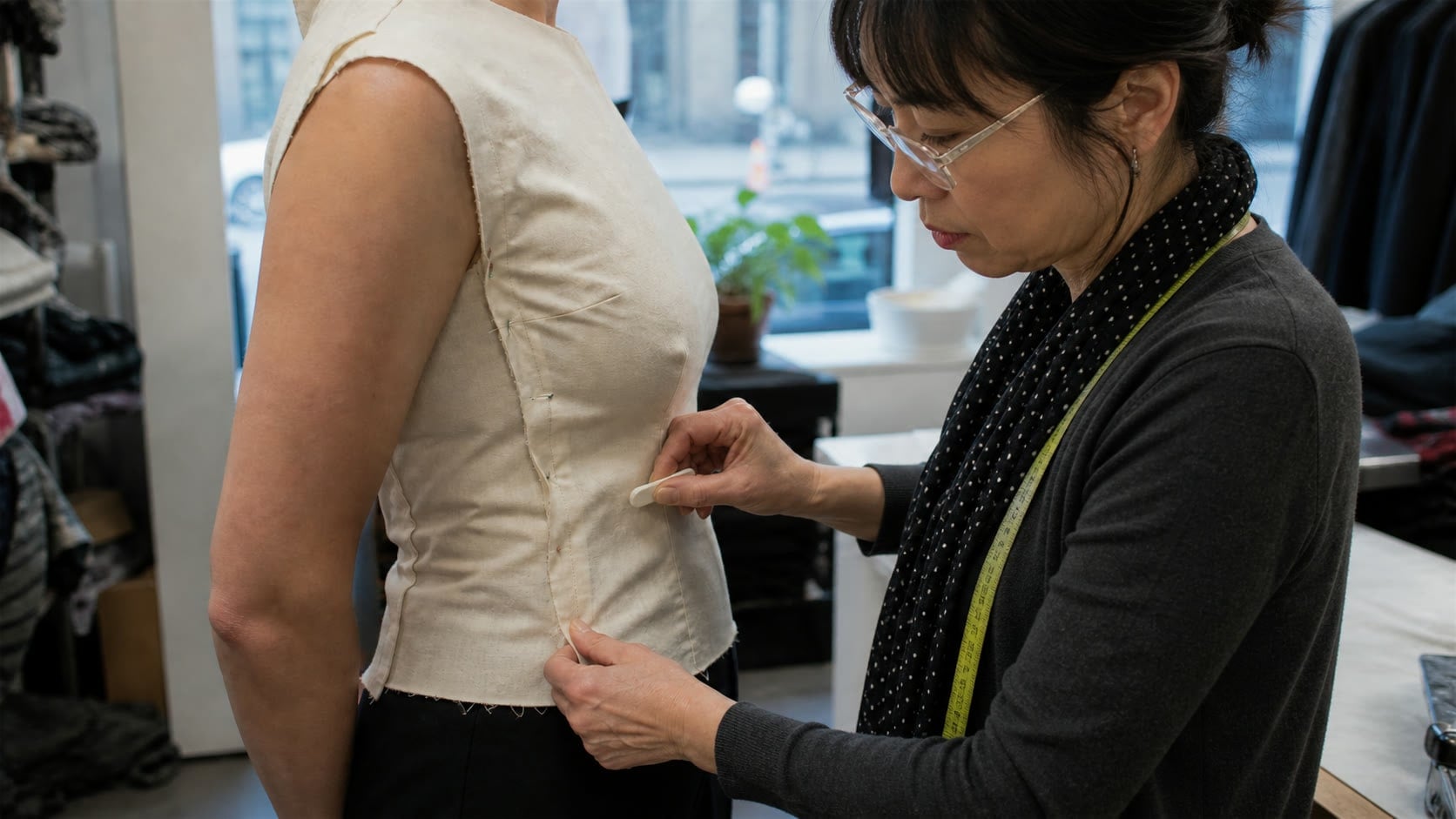
Why volume cutting hits a wall
The machinery of fast fashion is built around speed and quantity. Every pattern has to work 'well enough' across tens of thousands of units, which means it favours an average that few people actually are. When your torso, shoulders or leg length falls outside that range, the garment doesn't fail — it just never quite fits.
Where volume production hits a wall
These aren't isolated sizing accidents — they're built into how volume garments are cut.
- 01
Inconsistent sizes that change every season
Sizing is not regulated, so the same M can differ by several centimetres between brands and even from one collection to the next.
- 02
Size calculators that exclude real bodies
Some brand size tools simply stop when your measurements leave their pattern range; a tailor can still cut or alter a garment to fit you precisely.
- 03
Shoulder and posture issues ready-to-wear can't handle
Standard patterns assume an ideal posture and a generic shoulder slope, so jackets collapse at the back or pull at the front; the shoulder line and back balance can be adjusted to your posture.
- 04
Length and proportion mismatches
Trousers too long, sleeves over the hand, skirts at an unflattering point — shortening, lengthening and tapering bring proportions in line with your height.
- 05
Asymmetries factories ignore
Almost no body is perfectly symmetrical, but factory garments are cut as if they were; careful alterations adjust each side so the garment hangs straight on your real body.
The honest version
Not every piece is worth altering, and we'll tell you when it isn't. But when the cloth and the cut are good, fixing the fit is usually quick and turns a near-miss into something you actually reach for.
More guides
Taking clothes in to fit
Shirt, dress, trousers or jacket too wide? We take it in at the side seams, waist and sleeves so it fits instead of hanging loose. Waistband from €20, larger adjustments on request. Usually one to three working days.
Updated: September 2026Read more
What a tailor changes that brands cannot
Off-the-rack sizing is designed for a body that barely exists — the perfectly average one. A tailor starts from your actual measurements, and that shift changes how you carry yourself, how often you reach for a piece, and how much the clothes look like they cost.
Updated: September 2026Read more
Shortening trousers — guide and prices
Jeans from €12, suit trousers or chinos from €15. Usually one to three working days. Original hem (jeans) from €16. Workshop at Baumschulenstraße 36 in Berlin-Treptow, plus workshops in Bernau, Strausberg and Tangermünde.
Updated: September 2026Read more
Common questions about fit problems
Can a tailor fix a jacket that pulls across the back?
Often yes — the shoulder line and back balance can be adjusted to your posture, which is something no mass-produced piece is ever cut for.
Why does the same size fit differently between brands?
Sizing is not regulated, so each brand fills S, M and L with different measurements; a tailor works from your actual body instead of a label.
Are alterations worth it on cheaper clothes?
If the piece is comfortable and you like it, small alterations can make it look noticeably more tailored for far less than a new outfit.
Can asymmetries be corrected with alterations?
Yes — almost no body is perfectly symmetrical, but careful adjustment of seam lines and waistbands evens out side-to-side differences.
Is every piece worth altering?
Not necessarily — we'll tell you honestly when it's not. But when the cloth and the cut are good, fixing the fit is usually quick.
What can be done about sleeves or trousers that are too long?
Shortening, lengthening and tapering are standard jobs that adjust proportions to your body, so nothing bunches or hangs. We hem jeans from €12 and suit trousers from €15.
Ready? Stop by.