Guide · Invisible mending
Invisible mending: what disappears and what doesn't
Updated: September 2026
4 min read
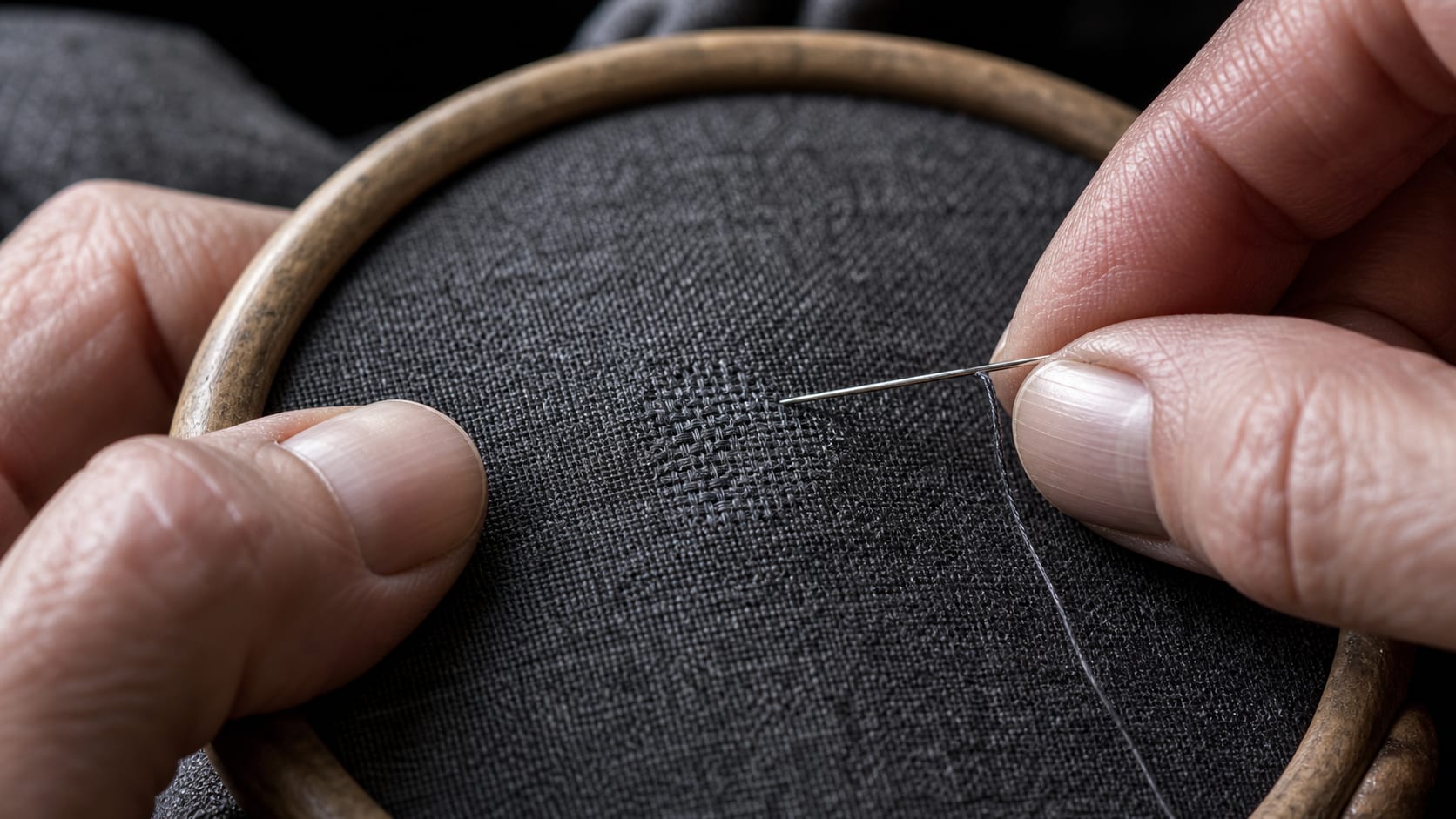
A moth hole in a cashmere jumper is smaller than a fingernail and still ruins the jumper. Invisible mending, Kunststopfen, rebuilds the weave thread by thread instead of covering it with a patch. How well it works comes down to size, weave and where the damage sits. Photo first, quote free — and you can post it to us from anywhere in Germany.
- Moth holes, burn holes, tears and thin patches — best in wool, cashmere and firm suiting
- The thread comes out of the garment itself, from a seam allowance or hem
- Photo first; the quote is free and commits you to nothing
- On large damage we advise against it — a visible seam from €15 is the honest answer
- Drop off at all our workshops, or post it from anywhere in Germany
Contents
Prices and process at a glance:
How your garment reaches us
Four steps from photo to return post. The quote is settled before you pack anything.
- 01
Send a photo of the damage
Lay the garment flat, photograph the spot in daylight, and put something familiar beside it — a coin is enough to judge the size by.
- 02
Wait for the quote
We tell you what is possible and what it costs. The quote is free and commits you to nothing.
- 03
Pack it clean and dry
The piece should be clean and dry. A note with your name and the spot in question saves a query.
- 04
Post it to the workshop that replied
The address comes with the quote. After the work it goes back to you well packaged by post.
What exactly is damaged
Four kinds of damage turn up most often, and they behave differently. A moth hole has soft, frayed edges and rarely arrives alone. A burn hole has a hard, scorched rim that has to come away before any mending can start. A tear usually runs with the grain and is longer than it is wide. A patch worn thin — at the elbow, the seat, the edge of a pocket — is not yet a hole at all, only the stage before one. Which is exactly why it is the easiest to save.
What the cloth is made of
The fibre decides more about the result than the price does.
- Wool and cashmere — the best case. The fibres bed into one another, and the new area felts in with the rest over time.
- Firm suiting cloth — even weave, clear grain, straightforward to rebuild.
- Very fine knitwear — possible, but the stitches are larger than anything we can set into them, so a repair tends to show.
- Smooth synthetics and coated fabrics — difficult. The new thread finds little to hold on to, and a coating cannot be rewoven. Ask us first on these.
- Patterned cloth — a herringbone or a check has to be carried on through the mend, or the eye lands on exactly the spot you were hoping to hide.
Where the thread comes from
The thread for the repair comes out of the garment itself. We take it from a seam allowance, from the hem, or from somewhere nobody ever sees — the inner facing of a pocket, for instance. It is the only way the colour, the weight and the twist genuinely match; bought thread almost never hits the colour of washed wool. On a piece that has already been shortened or altered, there is sometimes no reserve left. We see that when we assess it, and we tell you then.
What 'almost invisible' honestly means
Almost invisible means you have to know where the spot was in order to find it. At a metre's distance nobody sees anything. Up close, in raking light, held against the window, a careful eye picks it out — the mended area usually sits a shade denser than the cloth beside it. Anyone expecting a spot that cannot be found at all will be disappointed. Anyone who wants to wear the jumper again, as a rule, won't be.
When we advise against it
With large damage and with very fine knitwear we often advise against it. The work rises steeply with the area, and past a certain size Kunststopfen costs more than the garment is worth without the result getting any better. A visible, cleanly made repair is then the more honest answer: a patch on the inside, a deliberately contrasting seam, a darning stitch that admits what it is. It costs less and lasts just as long. Which of the two we would recommend is in the quote — and the quote costs nothing.
Price, turnaround and drop-off
All prices include 19% VAT. The final price is settled after the photo or the assessment.
- Invisible mending
- on request, priced after photo or assessment
- Quote
- free, commits you to nothing
- Turnaround
- by arrangement, depending on area and weave
- Drop-off
- all our workshops, no appointment
- By post
- from anywhere in Germany, after the quote
- Seam repair (visible)
- from €15, 1–3 working days
Before you seal the parcel
Wash or clean the piece first if it has been worn — we work bare-handed and close to the cloth, and a clean piece is easier to judge accurately. Put in everything that belongs to the same garment: the detached belt, the second glove, the loose scrap of fabric if you kept it. And if there are still moths in the wardrobe, the finest repair achieves little while the cause stays put. What actually helps is in our guide to caring for clothes.
More guides
Caring for wool, suits & leather
How to keep wool, suits and leather looking good for years: air rather than wash, store properly, keep moths out. And how to tell when care is no longer enough and a repair saves the piece.
Updated: September 2026Read more
Tent, horse rug, club flag: what fits through the machine
Not every repair is a garment. On the table: tent panels, backpacks, horse rugs worn through at the strap, boat covers, dog harnesses and embroidered club flags. The machines sew heavy cloth and leather — the question is rarely whether we can sew it, but whether the piece fits through the machine.
Updated: September 2026Read more
A memory bear from clothing: is one shirt enough?
Usually, yes. One shirt or blouse is enough for a bear, and whatever is left over comes back to you. We sew from clothing that carries a story: bears, cushions, small blankets, a christening gown out of a wedding dress. From €89 per bear, an introductory price. Everything else we work out unhurriedly in the workshop.
Updated: September 2026Read more
Common questions about invisible mending
What damage can be invisibly mended?
Moth holes, burn holes, tears and thinned patches — best in wool, cashmere and firm suiting cloth. The finer the weave and the smaller the damage, the more invisible the result.
Where do you get the thread?
Out of the garment itself — a seam allowance, the hem, or a hidden spot. It is the only way colour and weight match. If there is no reserve left, we tell you at the assessment.
Can I post clothing to you for invisible mending?
Yes, from anywhere in Germany. Send a photo of the damage first for a quote; the postal address comes back with our reply. After the work it returns to you well packaged.
What does the quote cost?
Nothing. It is free and commits you to nothing — including when we end up advising you against the repair.
Is invisible mending always worth it?
No, and we tell you beforehand. With large damage or very fine knitwear, a visible, clean repair is often the better and cheaper choice.
Ready? Stop by.